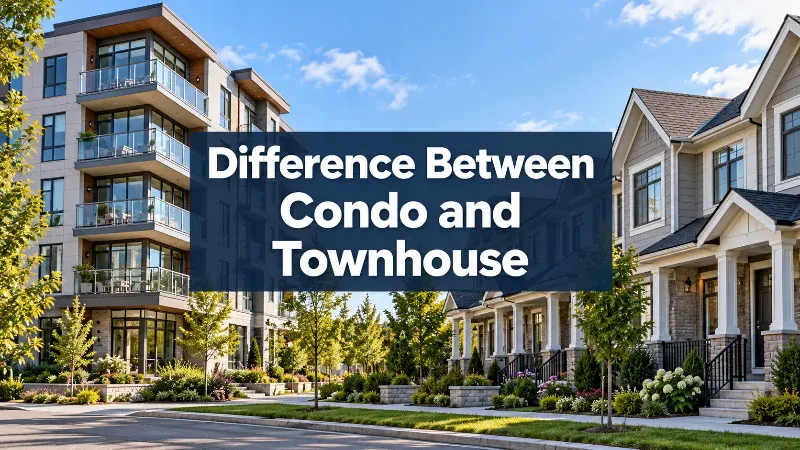
Two homes can look almost identical from the street yet come with different ownership rights, maintenance duties, and monthly expenses. That is why understanding the difference between condo and townhouse matters before you compare listings or make an offer.
The key distinction is that condominium describes a legal ownership arrangement, while townhouse describes a building style. Many townhouses come with ownership of an individual lot, but some operate under condominium ownership.
Appearance alone cannot tell you what you own or who pays for repairs. This guide explains the practical differences, the documents to check, and how to compare properties based on your budget and daily needs.
What Is a Condo?
A condominium, usually shortened to condo, is a property divided into individually owned units and shared common elements.
You own a defined unit and generally hold a shared ownership interest in common property. The declaration and other governing documents establish the boundaries of your unit and your rights in shared areas.
Condos can take several physical forms. They may resemble apartments, attached townhouses, or detached homes within a condominium development.
What Do Condo Owners Own?
The answer depends on the recorded documents and applicable state law.
Your unit might include specified interior surfaces and other components. Structural elements, roofs, land, and shared facilities may form part of the common property.
Avoid assuming that “everything inside is yours” fully explains the arrangement. Windows, pipes, balconies, and other components can have specific classifications and responsibilities.
What Does the Association Do?
A condominium association manages responsibilities assigned by the governing documents. These may include common-area maintenance, insurance, landscaping, and major building projects.
Owners contribute through regular assessments, commonly called dues or association fees.
Shared management reduces some individual tasks, but owners still pay collectively for the work.
What Is a Townhouse?
A townhouse is generally an attached home arranged beside neighboring homes, often across multiple floors. It usually has its own entrance and shares one or more side walls.
Some include a garage, patio, or small yard. Others have limited outdoor space.
The building’s appearance does not establish its legal ownership structure.
Fee-Simple Townhouse Ownership
With a fee-simple townhouse, you generally own the home and its individual parcel of land.
However, recorded covenants, easements, and association rules can still affect how you use or alter the property.
Ownership of the lot does not automatically mean unrestricted control over exterior changes.
Townhouses With Condominium Ownership
A townhouse-style home can legally be a condo.
For example, a row of two-story homes with separate front doors may belong to a condominium development. Their owners’ rights and obligations follow that legal structure.
This overlap explains why buyers should examine documents rather than rely on listing labels.
Difference Between Condo and Townhouse at a Glance
The following table compares condominium ownership with a typical fee-simple townhouse. Individual properties may differ.
| Factor | Condo | Fee-simple townhouse |
|---|---|---|
| Main description | Legal ownership arrangement | Building style with ownership of an individual parcel |
| Land | Usually part of shared common property | Generally included in the owner’s parcel |
| Layout | Can be stacked, attached, or detached | Usually attached side by side |
| Maintenance | Divided between owner and association | May involve more individual exterior responsibility |
| Association fees | Fund assigned shared expenses | Depend on whether an association exists and its duties |
| Outdoor space | May be common, exclusive-use, or part of the unit | May include privately owned yard space |
| Insurance | Must coordinate with association coverage | Must reflect ownership and association coverage |
| Financing | May require project-level review | Depends on legal classification and loan requirements |
Ownership and Land Rights
The difference between condo and townhouse becomes clearer when you ask what the deed and declaration actually describe.
A condo owner generally owns a unit alongside an interest in common property. A fee-simple townhouse owner generally owns a separately defined parcel and the home on it.
Neither description settles every practical question.
Private Use Is Different From Ownership
A patio reserved for one resident may still be a limited common element rather than individually owned land.
That distinction can affect who maintains it, who may change it, and who pays after damage.
Ask how yards, parking spaces, balconies, and storage areas are classified. Get clear answers before assuming you can fence, rebuild, or redesign them.
Maintenance and Repairs
Maintenance is one of the most useful comparisons because it affects both your time and your finances.
Condo Maintenance
An association may arrange work on common roofs, shared hallways, grounds, and other assigned components.
Owners may remain responsible for appliances, finishes, and systems serving their units. However, responsibility for a particular problem depends on the documents and circumstances.
A leaking pipe, for example, may require closer investigation into its location and the units it serves.
Townhouse Maintenance
A fee-simple townhouse owner may handle the roof, siding, yard, or driveway.
Some associations nevertheless maintain certain exterior components. Others manage only shared roads, landscaping, or amenities.
Request a written maintenance chart if available. Ask specifically about expensive components rather than accepting a general statement that the property is “low maintenance.”
Association Fees and Special Assessments
Another important difference between condo and townhouse is how communities divide shared costs. The amount of the fee alone does not tell you which option is less expensive.
Compare What the Fees Cover
A higher payment may include services you would otherwise purchase separately. A lower payment may leave more repairs and insurance costs to individual owners.
Review expenses such as:
- Building insurance.
- Exterior maintenance.
- Landscaping and snow removal.
- Shared utilities.
- Amenities.
- Reserve contributions.
- Professional management.
Compare coverage and responsibilities alongside the dollar amount.
Understand Special Assessments
A special assessment is an additional charge beyond regular dues. Associations may impose one for major work or other needs, subject to governing documents and applicable law.
Review reserve information, planned projects, meeting minutes, and notices about proposed assessments.
A modest monthly fee can become less appealing when substantial unfunded work is approaching.
Purchase Price and Total Monthly Cost
Neither housing type is always cheaper.
Location, size, condition, amenities, and local demand influence purchase prices. Association expenses and repair responsibilities affect ongoing affordability.
An Illustrative Comparison
Suppose one property has a hypothetical mortgage payment of $1,700 and association dues of $450. Another has a $1,900 mortgage payment and $150 dues.
| Expense | Property A | Property B |
|---|---|---|
| Mortgage payment | $1,700 | $1,900 |
| Association dues | $450 | $150 |
| Subtotal | $2,150 | $2,050 |
Property B has the lower subtotal, but the comparison remains incomplete. You still need taxes, insurance, utilities, maintenance, and any services excluded from dues.
These figures illustrate a method, not typical market prices.
Insurance Considerations
The difference between condo and townhouse also affects insurance, although the correct coverage follows the actual ownership documents and association policy.
Condo Insurance
An association’s master policy may cover certain building components and shared property.
An individual policy can address personal belongings, liability, covered unit components, and other needs. Available loss-assessment coverage may help with certain qualifying assessments, subject to policy terms.
Ask an insurance professional to identify gaps between the policies.
Townhouse Insurance
A fee-simple townhouse may require coverage for more of the structure.
However, some associations insure exterior components, which changes the analysis. Do not select insurance based only on the word “townhouse.”
Review deductibles, exclusions, and responsibility after a loss before closing.
Privacy, Layout, and Accessibility
Physical design affects daily comfort, but legal ownership does not guarantee a particular layout.
Shared Walls and Noise
Townhouses usually share side walls. Apartment-style condos may have neighbors above, below, or beside the unit.
Construction quality, floor coverings, traffic, and building systems can influence noise.
Visit during ordinary activity hours where possible. Ask about sound transmission rather than assuming one housing category is consistently quieter.
Stairs and Entrances
A townhouse’s separate entrance may be convenient, while multiple floors can create accessibility challenges.
A single-level condo may suit someone who prefers fewer internal stairs. However, elevators, entry steps, and the route from parking also matter.
Evaluate the complete journey into and through the home.
Rules, Renovations, and Rentals
Both ownership arrangements can involve restrictions.
Communities may regulate exterior changes, pets, parking, leasing, and use of shared facilities.
Making Changes
Owning a townhouse lot does not necessarily allow you to change the roof color, build a fence, or alter the façade without approval.
Condo renovations may require permission when they affect structure, plumbing, flooring, or shared systems.
Check approval procedures before budgeting for a project.
Renting Out the Property
If future rental use matters, investigate rental caps, minimum lease periods, registration requirements, and short-term rental restrictions.
Also check local rules and financing conditions.
Do not assume permission exists simply because another unit currently has tenants.
Financing and Future Resale
Lenders evaluate your finances and the property. A condominium purchase may also require review of the development’s insurance, financial condition, or other project characteristics.
A townhouse legally structured as a condo may face condominium-related requirements despite its appearance.
Discuss the exact property with your lender early.
Future resale depends on local demand, condition, expenses, and other factors. Neither housing type guarantees faster appreciation or an easier sale. Compare relevant local sales rather than relying on broad investment claims.
Documents to Review Before Buying
To understand the difference between condo and townhouse for a particular purchase, review the documents that assign ownership and responsibility.
Request, where applicable:
- Deed and recorded declaration.
- Covenants, bylaws, and community rules.
- Current budget and financial statements.
- Reserve study or reserve information.
- Recent meeting minutes.
- Insurance summaries and deductibles.
- Pending assessment and major-project notices.
- Maintenance responsibilities and rental policies.
Ask qualified professionals about unclear provisions. Combine document review with an independent inspection of the property.
Frequently Asked Questions
Can a townhouse also be a condo?
Yes. Townhouse describes a physical style, while condominium describes ownership. An attached, multilevel home can belong to a condominium development.
Do condos always have higher association fees?
No. Fees depend on services, insurance, amenities, maintenance obligations, and financial planning. Compare what owners receive and what they must pay separately.
Do townhouse owners always maintain their own roofs?
No. Some owners do, while some associations handle roof maintenance. The governing documents establish the responsibility.
Which option is better for a first-time buyer?
Neither is automatically better. Compare affordability, layout, maintenance duties, community finances, restrictions, and financing eligibility for the specific properties.
Can a condo include a private yard?
Yes, a condo can have outdoor space reserved for a particular unit. Check whether that space is individually owned, part of the unit, or a limited common element.
Conclusion
The difference between condo and townhouse starts with ownership and building style, then becomes practical through costs, maintenance, insurance, and community rules.
Look beyond the listing label. Check the documents, inspect the property, and compare complete ownership expenses.
The better choice is the specific home whose layout, obligations, and budget fit your needs.